New Roles in Production: Workflow Producers and AI Pipelines
A shift not just in technology, but in roles
Production workflows are changing, and so are the roles behind them.
In recent years, major studios and streaming platforms have started hiring for roles such as workflow producers, pipeline TDs, and production technology managers. This reflects a clear shift in the industry.
The focus is no longer only on creating content. It is on managing how that content moves through increasingly complex workflows.Industry trends reflect this shift, with platforms like LinkedIn showing increased demand for roles such as workflow producers, pipeline TDs, and production technology managers across media and entertainment.
Cloud systems, distributed teams, and AI driven pipelines have transformed production. As a result, a new challenge has emerged.
Someone needs to manage the workflow itself.
Not just the creative output. Not just the tools. But the entire system that connects them.
What is a workflow producer and a pipeline manager
These roles sit at the centre of modern production workflows.
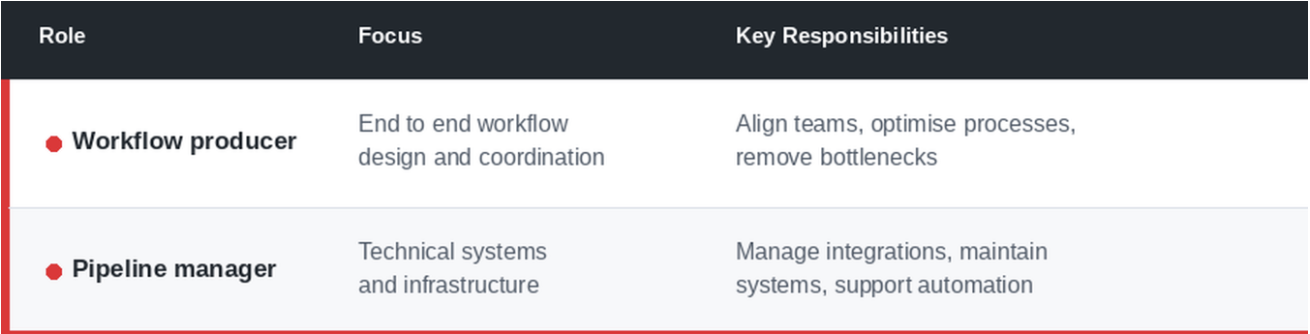
A workflow producer ensures that the production process runs smoothly from start to finish.
A pipeline manager focuses on the technical systems that make that workflow possible.
Together, they bridge the gap between creative teams and technical infrastructure
Why these roles are emerging now
The rise of these roles is driven by increasing complexity.
Modern production workflows involve:
- Distributed teams across multiple locations
- Cloud based tools and environments
- Continuous movement of large volumes of data
- Growing use of AI and automation
This complexity cannot be managed informally.
In the past, workflows were often handled through experience and direct communication. Today, that approach does not scale.
Workflows must be designed, monitored, and continuously optimised.
The impact of AI on workflow roles
Artificial intelligence is accelerating this shift.
AI tools are now used across editing, VFX, asset tagging, and content generation. These tools increase speed, but they also introduce new dependencies and processes. Industry organisations such as SMPTE highlight how AI and cloud based pipelines are increasing workflow complexity and requiring more structured orchestration.
AI requires:
- Structured and accessible data
- Integration with existing systems
- Clear input and output processes
Without proper coordination, AI can increase complexity instead of reducing it.
Workflow producers and pipeline managers ensure that AI fits into the workflow rather than disrupting it.
From creative pipelines to data pipelines
Production is evolving from a purely creative process into a data driven system.
Content is no longer only created and delivered. It is processed, versioned, analysed, and distributed across multiple platforms.
This requires a shift in thinking.
Teams must consider:
- How data moves across the pipeline
- How assets are structured and tracked
- How systems interact and depend on each other
This is where workflow visibility becomes essential.
The role of tools in enabling workflow visibility
Workflow roles depend on having the right tools and infrastructure.
Workflow producers and pipeline managers need visibility into how production operates. They need to understand where assets are, how they are used, and where bottlenecks occur.
Platforms like Core provide centralised asset management and version control, allowing teams to track content across the pipeline.
Infrastructure solutions like Media Fabric connect connectivity, cloud access, security, and data movement into a unified system. This enables workflow orchestration across distributed environments.
These tools do not replace workflow roles. They enable them to operate effectively.
A shift in responsibility across production teams
The emergence of workflow roles reflects a broader shift in how production teams operate.
Production is no longer divided strictly between creative and technical teams.
Workflow producers must understand both creative goals and technical constraints. Pipeline managers must balance system performance with usability.
This creates a more integrated model where workflows are a shared responsibility across disciplines.
Hiring for the future of production
Studios are increasingly looking for hybrid skill sets.
In addition to workflow producers and pipeline managers, related roles are gaining importance, including:
- Pipeline TD
- Production technology manager
- DevOps for media
These roles require individuals who can:
- Understand complex workflows
- Work across technical and creative domains
- Adapt to evolving tools and systems
- Manage both processes and people
This marks a shift away from narrow specialisation towards broader, cross functional expertise.
Workflow as a competitive advantage
In an environment where tools are widely available, workflows become the differentiator.
Two teams may use the same tools, but the team with a well designed workflow will operate more efficiently and deliver better results.
Workflow producers and pipeline managers play a key role in creating this advantage.
They ensure that systems support creativity instead of slowing it down.
From execution to orchestration
Modern production is shifting from execution to orchestration.
Success is no longer defined only by the ability to create content. It is defined by the ability to manage how that content moves, evolves, and is delivered across complex systems.
Final thoughts
The future of production is not just about better tools. It is about better workflows.
As pipelines become more complex and AI becomes more integrated, workflow roles will continue to grow in importance.
Workflow producers and pipeline managers are becoming essential parts of modern production teams.
In 2026, the ability to design and manage workflows effectively is as important as the ability to create content.
FAQ
What is a workflow producer in media production?
A workflow producer is responsible for designing and managing production workflows, ensuring that tools, teams, and processes work together efficiently.
What does a pipeline manager do?
A pipeline manager focuses on the technical systems behind production, managing integrations, maintaining infrastructure, and supporting automation.
Why are new workflow roles emerging in production?
These roles are emerging due to increasing complexity from distributed teams, cloud workflows, and AI driven processes.
How is AI changing production roles?
AI introduces new processes and dependencies, requiring specialised roles to manage integration, data flow, and workflow coordination.
What skills are needed for workflow roles?
Key skills include understanding workflows, working across technical and creative domains, and managing systems and processes.
What are related roles to workflow producers?
Related roles include pipeline TD, production technology manager, and DevOps for media.
Why are workflows becoming a competitive advantage?
Well designed workflows improve efficiency, reduce delays, and enable better collaboration, giving teams an operational advantage.
Explore how Core and Media Fabric support modern production roles by enabling workflow visibility, control, and orchestration across complex and distributed pipelines.

Get the latest news and updates from Sohonet in your inbox
More from the blog
View all
.webp)
.webp)