Real-Time vs Async Workflows in Post Production Explained
.webp)
The shift in how creative teams collaborate
Post production has moved beyond the boundaries of a single room.
Teams are now distributed across locations, time zones, and workflows. Editors, VFX artists, producers, and stakeholders collaborate without being physically present together. This shift has changed how work is shared, reviewed, and approved.
At the centre of this shift is a key question.
Should collaboration happen in real time, or asynchronously?
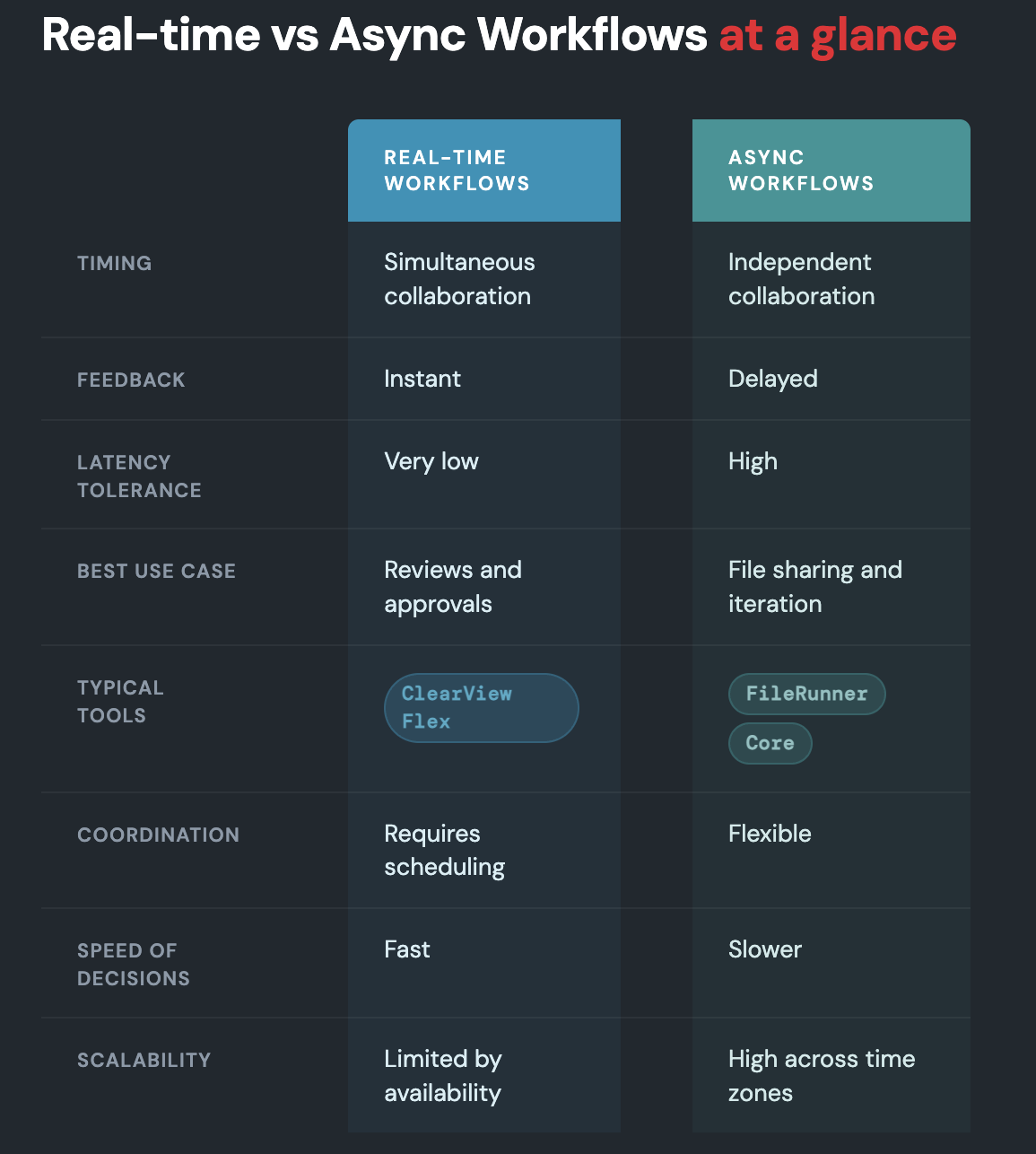
Real-time workflows involve teams working together simultaneously, with instant feedback and shared viewing.
Async workflows allow teams to work independently, reviewing and responding at different times.
This is no longer just a preference. It is a strategic decision that shapes efficiency, speed, and workflow performance.
The advantage of real-time collaboration
Real-time workflows are most effective when alignment is critical.
Creative decisions often depend on shared understanding. Subtle changes in timing, colour, sound, or performance are best evaluated when everyone is viewing the same content at the same time.
When teams collaborate in real time:
- Feedback is immediate and contextual
- Misunderstandings are resolved quickly
- Decisions are made collectively
- Creative momentum is maintained
This is especially important in review sessions, where fragmented feedback can lead to unnecessary iterations.
Solutions like ClearView Flex enable real-time collaboration across distributed teams by providing frame accurate playback with low latency.
The role of async workflows in production
While real-time collaboration is powerful, it is not always practical.
Teams operate across time zones and schedules. Not every task requires immediate interaction. In many cases, async workflows are more efficient.
Async collaboration allows teams to:
- Share work without coordinating schedules
- Review content at their own pace
- Manage multiple tasks in parallel
- Maintain progress without waiting for availability
This is ideal for file delivery, version tracking, and iterative tasks that do not require immediate alignment.
Tools like FileRunner support async workflows through secure and reliable file transfer. Platforms like Core enable structured asset and version management.
Where workflows break down
Problems arise when workflows are not clearly defined.
If everything is async, decisions slow down and feedback becomes fragmented. Teams may work on different versions without alignment.
If everything is real-time, coordination becomes difficult. Scheduling delays can slow progress and reduce efficiency.
The issue is not choosing one approach. It is using each in the wrong context.
When to choose real-time vs async
Use real-time workflows when:
- Creative alignment is critical
- Immediate feedback is required
- Decisions need to be made quickly
- Final approvals are taking place
Use async workflows when:
- Teams are distributed across time zones
- Work can progress independently
- File transfer and versioning are the priority
- Tasks do not require immediate discussion
The most effective workflows combine both approaches strategically.
The importance of integration
Even when both approaches are used effectively, problems can arise if they are not connected.
If real-time review happens in one system and async collaboration in another, context can be lost. Feedback may not carry over. Versions may become misaligned.
This introduces friction into the workflow.
Integrated environments reduce this friction by connecting both modes of collaboration.
Solutions like Media Fabric bring together connectivity, cloud access, file transfer, and collaboration into a unified system. This ensures that content, feedback, and decisions remain aligned across the production pipeline.
From collaboration modes to workflow strategy
Real-time and async workflows are not competing approaches. They are complementary.
Real-time collaboration supports alignment and fast decision making.
Async collaboration supports flexibility and continuous progress.
Together, they create workflows that are both efficient and adaptable.
The impact on modern production teams
As production evolves, balancing real-time and async workflows becomes essential.
Teams that integrate both effectively can:
- Move faster without sacrificing quality
- Maintain alignment across distributed teams
- Reduce delays and rework
- Scale workflows efficiently
This balance is a defining factor in modern production performance.
Final thoughts
The question is not whether to use real-time or async workflows.
Both are essential.
The real challenge is knowing when to use each and how to combine them effectively.
Modern production depends on workflows that support both instant collaboration and independent progress without creating fragmentation.
Teams that achieve this balance operate with greater speed, clarity, and efficiency.
FAQ
What is the difference between real-time and async workflows?
Real-time workflows involve simultaneous collaboration with instant feedback, while async workflows allow teams to work independently and respond at different times.
When should real-time workflows be used in post production?
Real-time workflows are best for creative reviews, approvals, and situations where immediate alignment is required.
When are async workflows more effective?
Async workflows are ideal for file sharing, version tracking, and tasks that do not require immediate feedback, especially across time zones.
Can real-time and async workflows be used together?
Yes. The most effective production workflows combine both approaches, using real-time for alignment and async for flexibility.
What tools support real-time collaboration?
Tools like ClearView Flex enable real-time collaboration with low latency and frame accurate playback.
What tools support async workflows?
Solutions like FileRunner and Core support async workflows through secure file transfer and structured asset management.
Why is integration important between real-time and async workflows?
Without integration, workflows become fragmented. Connecting both approaches ensures consistency, visibility, and efficiency across the production pipeline.
Explore how ClearView Flex, FileRunner, Core, and Media Fabric support both real-time and async workflows, enabling instant collaboration, secure file transfer, structured asset management, and fully connected production pipelines.

Get the latest news and updates from Sohonet in your inbox
.png)
.webp)