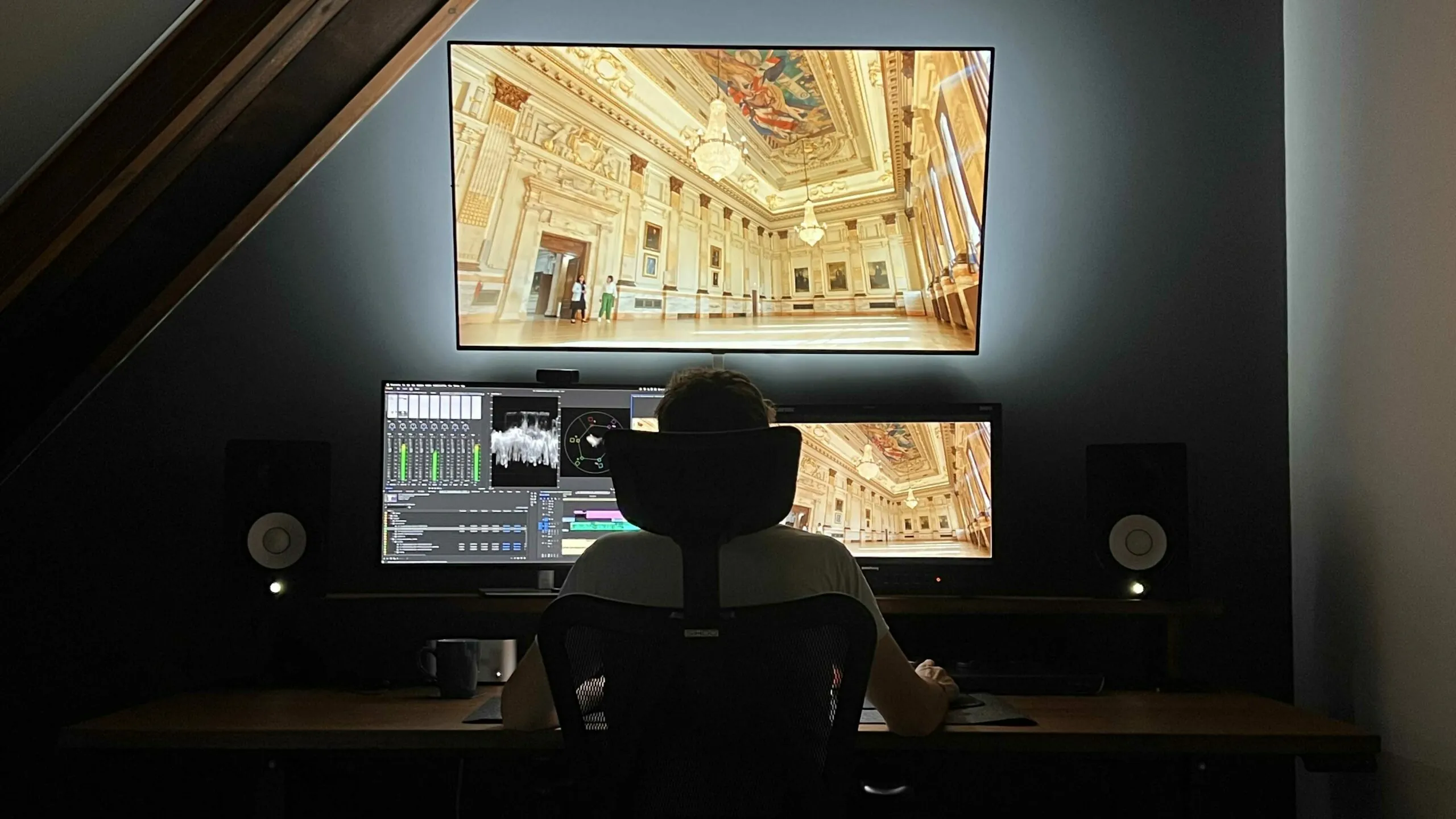
Why Low Latency Matters in Creative Collaboration Workflows

The invisible factor shaping creative collaboration
Modern post production depends on remote collaboration.
Teams work across locations, devices, and networks, reviewing content and making decisions without being in the same room. Editors, directors, VFX artists, and producers rely on digital tools to stay aligned.
Distributed workflows are now standard.
Latency is now the defining factor of collaboration quality.
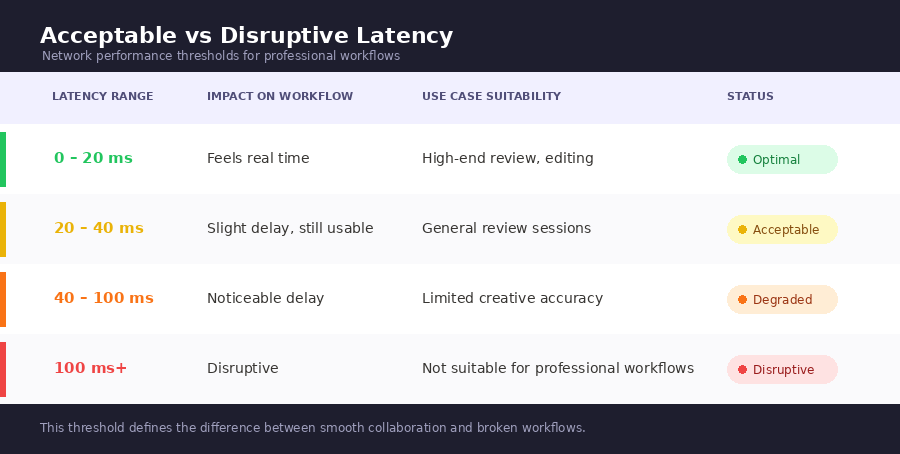
Latency is the delay between an action and its visible or audible result. In professional post production, even delays above 40 to 100 milliseconds begin to disrupt perception and decision-making.
This is not theoretical. It directly affects how teams experience content.
What is latency in creative workflows
Latency is measured in milliseconds and represents the delay between playback, interaction, and feedback.
In post production workflows, this includes:
- Delay between playback and viewing
- Audio and video synchronisation lag
- Delay in communication during review sessions
- Slow response when interacting with content
In high-end creative workflows (ITU-T G.114):
- Below 20 ms feels instant
- 20 to 40 ms is acceptable for most review
- Above 40 ms begins to disrupt timing perception
- Above 100 ms significantly impacts collaboration
Creative work depends on precision. Small delays change how edits, transitions, and performances are perceived.
Why latency breaks creative flow
Creative collaboration depends on flow.
Flow is the state where feedback is immediate and decisions happen naturally.
Latency breaks this state.
When delay is introduced, the connection between action and feedback weakens. Conversations become fragmented. Reactions lose timing. Momentum slows.
Instead of reacting instantly, teams start compensating for delay.
Over time, this reduces both productivity and creative quality.
Acceptable vs disruptive latency
The compounding effect in distributed teams
Latency increases in distributed environments.
Remote teams depend entirely on digital systems. Any delay is amplified across playback, communication, and feedback.
This leads to:
- Feedback arriving out of sync
- Conversations overlapping or stalling
- Slower decision-making
The result is more revisions, more review cycles, and reduced efficiency.
Latency impacts the entire workflow, not just individual interactions.
Why traditional remote tools fall short
Many remote collaboration tools prioritise accessibility over performance.
Compression, buffering, and network variability introduce delays that are not acceptable for professional workflows.
These tools struggle to provide:
- Frame accurate playback
- Consistent visual quality
- Synchronous collaboration
As a result, teams adapt to limitations instead of working in optimal conditions.
Recreating real-time collaboration
Effective remote review must replicate in-room collaboration.
This requires:
- Ultra low latency
- Frame accurate playback
- Audio video synchronisation
- Immediate communication
Technologies such as SMPTE ST 2110, NDI, and PCoIP highlight how professional environments prioritise low latency and high fidelity media transport.
Solutions like ClearView Flex apply these principles to enable low latency remote review across distributed teams.
Stakeholders see the same content at the same time and can respond instantly.
Latency and decision-making speed
Latency directly impacts decision-making.
When feedback is delayed, decisions slow down. When decisions slow down, workflows lose momentum.
With low latency remote review:
- Feedback is immediate
- Alignment is faster
- Iterations are reduced
- Projects move forward efficiently
Latency is not just a technical metric. It is a driver of workflow speed.
Latency and confidence
Confidence depends on accuracy.
If playback is delayed or inconsistent, stakeholders lose trust in what they see and hear.
This leads to hesitation, additional reviews, and slower approvals.
Low latency restores confidence.
When teams trust the accuracy of playback, they make decisions faster and with greater certainty.
From technical detail to strategic advantage
Latency is not just a technical issue. It is a competitive factor.
Teams that minimise latency can:
- Collaborate effectively across locations
- Maintain creative flow
- Reduce unnecessary revisions
- Deliver projects faster
Teams that do not will continue to experience friction and delays.
Final thoughts
Latency defines the quality of modern creative collaboration.
In distributed workflows, even small delays affect how teams think, react, and decide.
Low latency remote review is no longer optional. It is essential.
In 2026, the ability to collaborate in real time without delay is a core requirement for production teams.
FAQ
What is low latency in post production workflows?
Low latency refers to minimal delay between playback and viewing, typically below 40 milliseconds, enabling accurate and real-time collaboration.
Why is low latency important in remote review?
Low latency ensures that all participants see and hear content at the same time, allowing for immediate feedback and accurate decision-making.
What latency level is acceptable for creative work?
Latency below 20 ms is ideal, while 20 to 40 ms is generally acceptable. Above 40 ms begins to affect creative accuracy.
How does latency affect collaboration?
Latency disrupts timing, delays feedback, and slows decision-making, leading to inefficiencies and additional revisions.
What technologies support low latency workflows?
Technologies such as SMPTE ST 2110, NDI, and PCoIP enable high-quality, low latency media transport for professional workflows.
How does ClearView Flex reduce latency?
ClearView Flex enables ultra low latency, frame accurate remote review, ensuring that teams can collaborate in real time without disruption.
Discover how ClearView Flex enables low latency remote review with frame accurate playback, helping creative teams collaborate, align, and make decisions in real time without breaking workflow momentum.

Get the latest news and updates from Sohonet in your inbox
.png)
.webp)