Signs your distributed workflow is costing you more than you think


The problems don’t usually announce themselves...
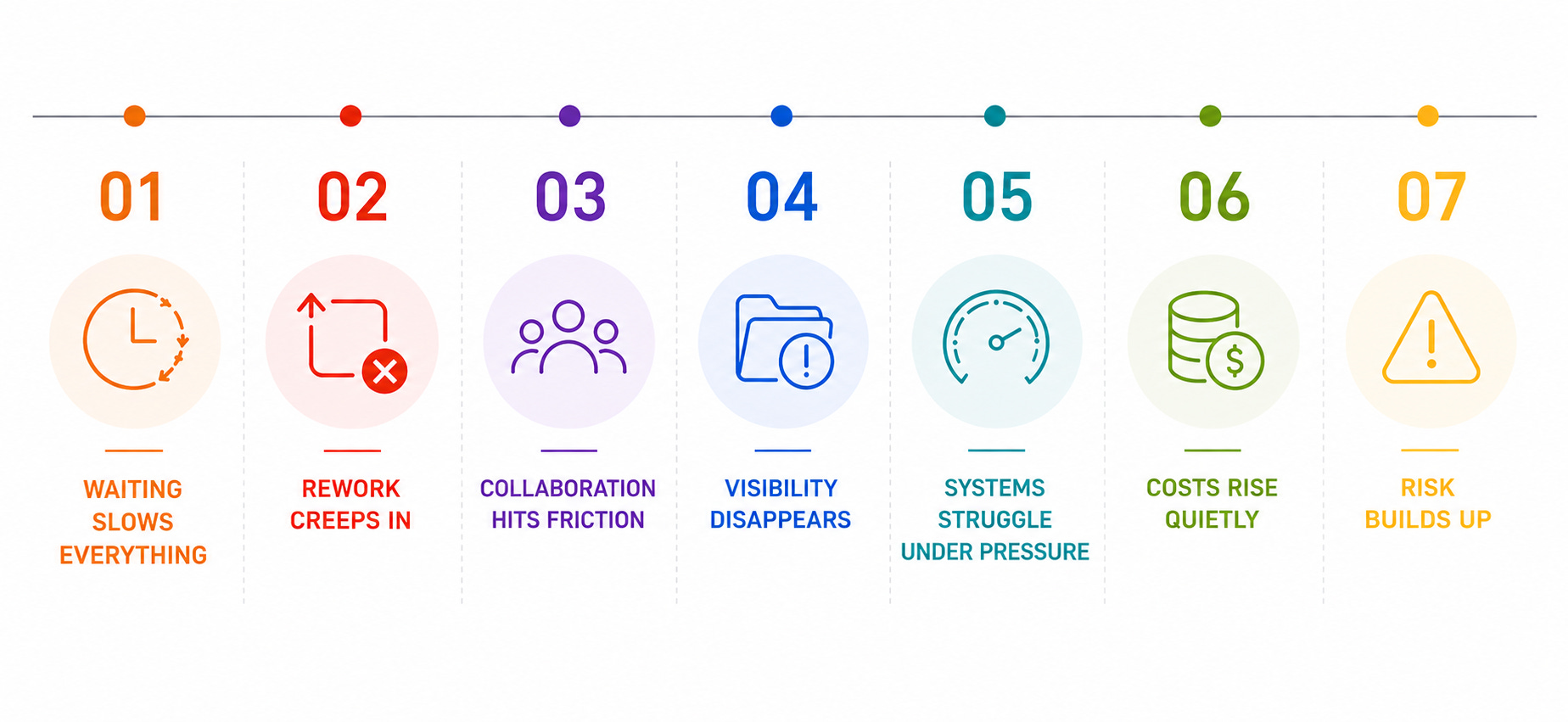
It’s an artist waiting before they can start work. Two editors have both saved to the same file, and now no one’s quite sure which version is right. A coordinator spending their morning reconciling what should have been the same asset at two different sites. A project that wrapped months ago but the data is still spread across locations nobody has fully audited…
None of it looks catastrophic. It just quietly slows everything down.
Most of these issues usually come back to the same thing: the shared workspace underneath the workflow just isn’t keeping up with how people actually work now.
Here’s what to pay attention to.
Your artists wait before they can start
If files have to be staged before a session begins, that delay is baked into every working day. It might be ten minutes. It might be thirty. Either way, it’s dead time before anyone’s touched a frame.
The expectation in a modern distributed workflow is that content is there when you open the tool. Not after a download completes. Not after a staging window. Now. Artists should be able to open a large media file and get straight to work while it continues loading in the background - not sit waiting for a transfer to finish before they can begin.
Versions drift between sites
This one is pretty subtle until it costs you. Two teams working concurrently. Both saving. Neither fully aware of what the other has. The file at one facility is different from the file at the vendor. Someone has to reconcile them, usually under deadline pressure, usually without clean tooling to help.
That reconciliation job is a symptom of a workspace that wasn’t built for concurrent, multi-site work. When changes propagate automatically to every connected contributor, the problem doesn’t arise.
Your team is managing moves instead of doing the work
If someone is responsible for moving files between sites; scheduling windows, monitoring jobs, restarting failures, that’s operational overhead that belongs to a different era. It also means your pipeline has a gap: something has to happen between one site finishing work and another being able to start. That gap might be hours. Across a production schedule, it compounds.
A workspace where every change reaches every connected site automatically removes the gap entirely. No manual triggers. No transfer windows. No one watching a progress bar.
Nobody’s fully confident which version is current
File conflicts aren’t just frustrating, they’re a trust problem. If artists can’t be sure that what they’re opening is the current version, they start working around the system: checking with the coordinator, keeping local copies, double-saving to shared drives. Those workarounds create the fragmentation they’re trying to avoid.
The answer isn’t better discipline. It’s a workspace that handles conflict resolution automatically - where the most recent save is always the hero file, older versions are archived rather than lost, and everyone is working from the same source of truth.
Work stops when the connection drops
A distributed workspace that depends on a live connection to function isn’t truly distributed. If one site loses connectivity and work stops, or worse, continues on a diverging copy that has to be reconciled later, the foundation isn’t solid enough for production conditions.
Resilient shared workspaces keep files physically present at every site. Work continues if the connection drops. When it comes back, it changes sync automatically from where they stopped. No intervention, no data loss, no cleanup operation.
The question underneath all of it
These problems show up across facilities of every size and productions of every scale. What varies is how much of the team’s energy goes into absorbing them.
No rip and replace needed. The real shift isn’t faster tools bolted onto an existing setup, it’s a shared workspace designed for how distributed creative work runs today: concurrent, multi-site, always on, and invisible to the artists using it.
If any of this resonated, get in touch. Resilio Active Everywhere on Sohonet is built for exactly these conditions.Talk to our team.

Get the latest news and updates from Sohonet in your inbox
More from the blog
View all
.webp)
.webp)