The Budget and the Post-Production Bill: What 28 October Changed
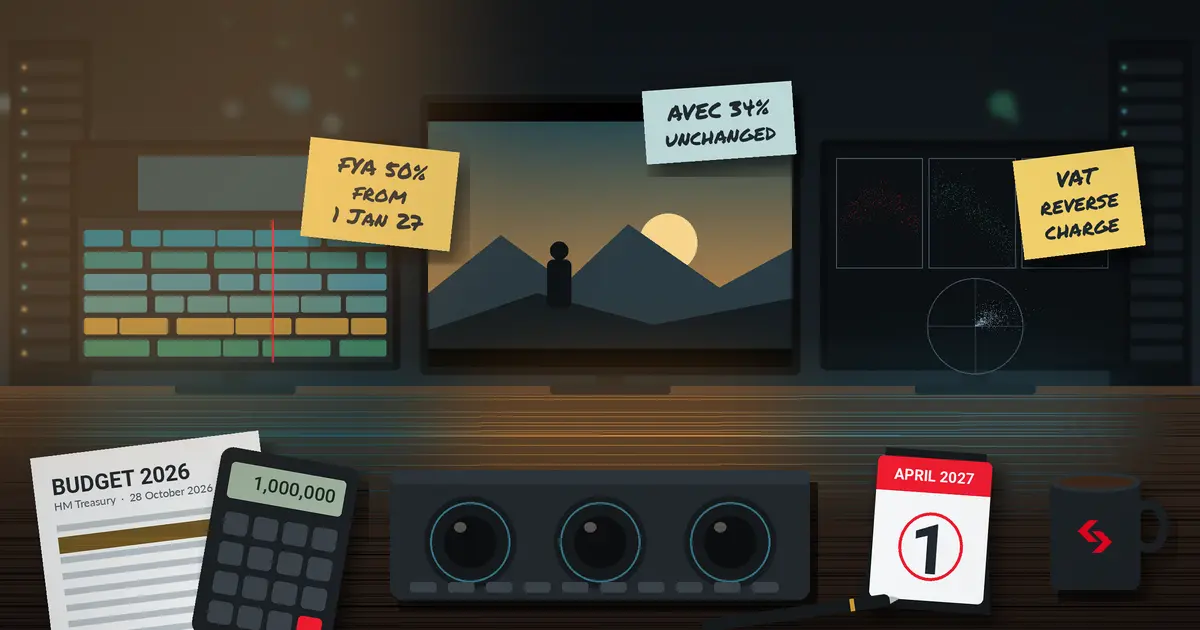
The UK Budget of Wednesday 28 October 2026 left the film and television tax credits where they were. The Audio-Visual Expenditure Credit stays at 34% for film and high-end TV, 39% for animation and children’s TV, 53% for independent film, and 39% on qualifying visual effects costs. For post-production, the changes sit elsewhere: a higher first-year allowance on new kit from 1 January 2027, a lower writing down allowance from April 2027, UK VAT on overseas services bought by businesses that are not VAT-registered from 1 April 2027, and simpler R&D claims.
The credits: unchanged, and the old reliefs end in April
The overview of tax legislation and rates published with the Budget lists the same credit rates for 2027 to 2028 as for 2026 to 2027: 34% for film and high-end TV, 39% for animation (film and TV) and children’s TV, 53% for independent film, and 39% for qualifying visual effects (VFX) costs. The same document confirms that the older film, high-end TV, animation and children’s TV tax reliefs cease from 1 April 2027, completing the move to the Audio-Visual Expenditure Credit.
That stability matters because of where the money comes from. The BFI’s official figures put UK film and high-end TV production spend at £6.8 billion in 2025, a 22% increase on 2024’s first reported figures, with inward investment productions making up £5.8 billion of it, or 85%. An unchanged credit means the figure productions budget against for 2027 stays where it was. Sohonet has written before about how tax incentives move productions between countries and what swings in spend do to post vendors. This Budget did not add a new swing.
The kit bill: capital allowances
Capital allowances are the tax relief a business gets on equipment and machinery it buys: for a facility, the storage, servers, workstations and network equipment. The Budget kept full expensing, which lets a company deduct 100% of the cost of qualifying new plant and machinery in the year it is bought, and the £1 million annual investment allowance. It changed two other rates.
The main-rate first-year allowance rises from 40% to 50% for expenditure incurred on or after 1 January 2027. The 40% allowance was introduced from 1 January 2026 and, unlike full expensing, is open to unincorporated businesses and to assets bought for leasing. It does not cover cars, second-hand assets or assets leased overseas.
The main-rate writing down allowance falls from 14% to 12%, from 1 April 2027 for companies and 6 April 2027 for income tax. This is the yearly rate at which whatever is left in the main pool is relieved.
For most post-production companies buying new kit, nothing changes: full expensing still gives 100% in the first year. The change lands on two groups. Businesses that buy kit to hire out, which full expensing does not cover, get 50% rather than 40% on new kit bought from 1 January 2027 that the annual investment allowance does not already cover, so a purchase in December 2026 and one in January 2027 are treated differently. And any business with a balance left in its main pool, from older kit or second-hand kit bought above the annual investment allowance, will see that balance relieved more slowly from April 2027.
Two limits on all of this. Sole traders and partnerships using the cash basis can only claim capital allowances on business cars, so these changes do not reach freelancers who use it. And cloud services paid for monthly are not equipment, so nothing here changes their cost.
VAT: overseas services and the reverse charge
The Budget made no increase to the headline rate of VAT, and the registration threshold stays at £90,000 in both years. One change reaches small post-production businesses directly.
When a supplier outside the UK sells a service to a UK business, the business, not the supplier, usually accounts for the VAT, under what is called the reverse charge. If the business is not VAT-registered, no VAT is paid on the service today, though its value counts towards the registration threshold. From 1 April 2027, the reverse charge will only apply when the buying business is registered for VAT. Where it is not, the overseas supplier will be required to charge UK VAT and pay it to HMRC.
For a freelancer or small company below the threshold buying services from suppliers based outside the UK, such as software subscriptions or online tools, that can mean VAT at the standard 20% on those bills, which an unregistered business cannot reclaim. HMRC expects the change to raise £70 million in 2027 to 2028 and £75 million a year after that.
Large groups: interest and the credits
A technical change touches the largest production groups. The Corporate Interest Restriction limits how much interest a large group can deduct, by reference to its taxable earnings. From 1 January 2027, Audio-Visual Expenditure Credits and Video Games Expenditure Credits will be left out of those earnings. HMRC says the credits had been counted in, which let affected groups deduct more interest than intended. It applies only to businesses with net interest and other financing costs above £2 million a year. HMRC expects around 1,000 groups to claim the two credits, for only some of whom this will be relevant, and puts the effect on revenue as negligible.
R&D claims get simpler
For a facility that already claims R&D tax relief, the paperwork shrinks. The Claim Notification Form is removed from 1 April 2027, and the Additional Information Form is simplified from autumn 2027. The R&D Expenditure Credit stays at 20%.
What else the Budget names for the screen industries
The Budget commits £20 million from the Growth Mission Fund towards turning the Littlewoods site in Liverpool into a 260,000 square foot creative campus for film, TV, gaming, immersive technology and digital screen industries, subject to a final business case. It also lists over £75 million into the CoSTAR network of creative industries research labs in Yorkshire, Dundee, Belfast, Buckinghamshire and Surrey, as national infrastructure for the UK’s creative industries. And a new Data Centre Covenant sets tests for strategic data centres, with faster grid connections for those that meet them, while a draft National Policy Statement for data centres is out for consultation. The cloud capacity post-production uses runs in buildings like these.
What it did not do matters too. There is no increase to the headline rates of income tax, National Insurance or VAT. Employers’ National Insurance stays at 15% above the secondary threshold, and the Employment Allowance stays at £10,500. The business rates support goes to retail, hospitality and leisure, and the electricity discount to energy-intensive manufacturers. Neither is aimed at post-production.
Before April 2027
If you buy kit to hire out, look at the timing of purchases either side of 1 January 2027. If you are not VAT-registered, list the services you buy from suppliers outside the UK, because from 1 April 2027 they may arrive with VAT added. If your group’s net interest costs are above £2 million a year and you claim the credit, check your interest restriction position for periods from 1 January 2027. And if you claim R&D relief, note that the Claim Notification Form goes from 1 April 2027.
This is a reading of the published Budget documents, not tax advice. Talk to your accountant before acting on any of it.
Where Sohonet sits
The credits set the rate. How much gets made is a separate question. Sohonet’s Screen Production Index counts new scripted production starts every month, and its October edition recorded September’s starts at 31% below September 2025, with three of the largest 2026 commitments, two of them UK shoots, moved into early 2027. An unchanged credit keeps the UK’s offer steady while those dates settle.
Sources. HM Treasury: Budget 2026 (HC 726, 28 October 2026), the main document and its list of policy decisions; Overview of Tax Legislation and Rates, Annex A: rates and allowances (28 October 2026). HMRC: Corporate Interest Restriction: creative reliefs and tax-EBITDA calculation and Reform of the business to business reverse charge for supplies of services from overseas (both 28 October 2026); Capital allowances: new first-year allowance and reducing main rate writing-down allowances (26 November 2025). GOV.UK guidance: Claim capital allowances, full expensing and VAT rates. GOV.UK consultation: draft National Policy Statement for data centres. BFI: Official BFI statistics for 2025 (5 February 2026). Sohonet: Screen Production Index, October edition (16 October 2026).

Get the latest news and updates from Sohonet in your inbox